

- Katılım
- 4 Şub 2022
- Mesajlar
- 14,496
- Beğeni
- 12,790
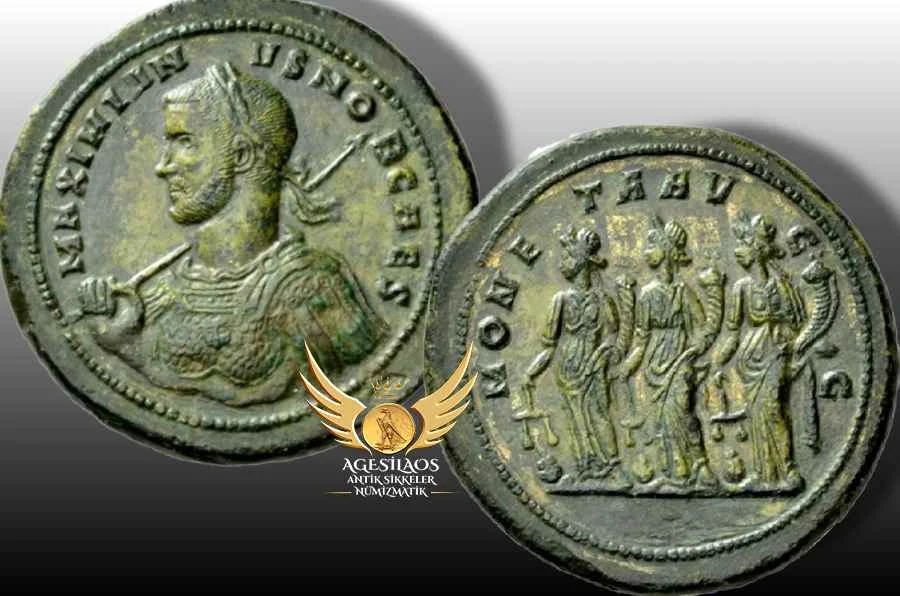
This bronze medallion bears a powerful image of the Caesar Galerius wearing an ornate cuirass decorated with a gorgoneion, and holding a spear over his far shoulder. At the Rome mint, where this medallion presumably was struck, the obverse inscription MAXIMIANVS NOB CAES was otherwise used only for a single issue of nummi [folles] which Sutherland dated to circa 302-303.
If a connection may be drawn, we might consider that this medallion was struck contemporarily with these nummi. During that period Galerius was fighting hard to defend the Danube from barbarian incursions, which accords well with this military bust type. During this time he also was wintering with Diocletian at Nicomedia, where the two are thought to have formulated a plan for what would come to be known as the Great Persecution.
The reverse type, the Tres Monetae , is the most familiar for Roman medallions of the third century. It perhaps makes its first appearance on a brass medallion of Commodus, soon after which it became the most commonly employed reverse type up through the Constantinian Era. Each of the three figures holds a cornucopia and a set of scales, and stand beside a heap of coins. Invariably the two outer figures hold scales hung at the end of rods or cords of more or less equal length, whereas the central figure suspends her scale from a longer rod or cord. Since the figures represent the three principal coining metals – gold, silver and copper – we may presume the central figure represents gold, and that her different presentation reflects the greater nobility of her metal.
If a connection may be drawn, we might consider that this medallion was struck contemporarily with these nummi. During that period Galerius was fighting hard to defend the Danube from barbarian incursions, which accords well with this military bust type. During this time he also was wintering with Diocletian at Nicomedia, where the two are thought to have formulated a plan for what would come to be known as the Great Persecution.
The reverse type, the Tres Monetae , is the most familiar for Roman medallions of the third century. It perhaps makes its first appearance on a brass medallion of Commodus, soon after which it became the most commonly employed reverse type up through the Constantinian Era. Each of the three figures holds a cornucopia and a set of scales, and stand beside a heap of coins. Invariably the two outer figures hold scales hung at the end of rods or cords of more or less equal length, whereas the central figure suspends her scale from a longer rod or cord. Since the figures represent the three principal coining metals – gold, silver and copper – we may presume the central figure represents gold, and that her different presentation reflects the greater nobility of her metal.